Key Technical Parameters and Control Points for Leaf Tobacco Bulk Fermentation (Pilón)
Conclusion First
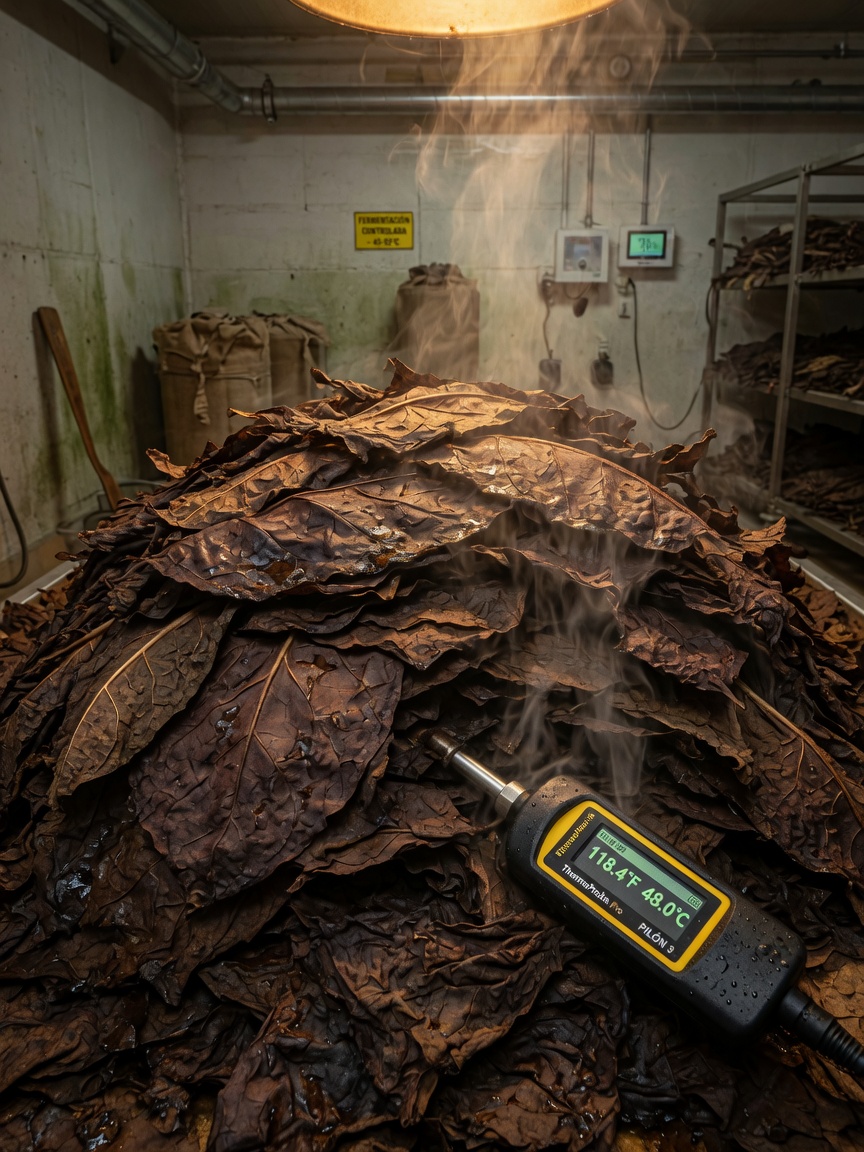
Pilón (bulk fermentation) is not about piling tobacco leaves together and waiting for them to heat up naturally. It uses the heat generated by leaf respiration, microbial activity and moisture migration, and controls the process through turning, humidification, heat dissipation and re-arrangement. On site, you cannot only watch a single "pile core temperature". You should simultaneously watch the temperature trend, moisture content, aroma, and the color, oil content and feel of the leaves.
I. A Parameter Window That Can Serve as a Starting Point for Small-Scale Trials
The table below lists common reference ranges found in published research and process literature. These are not mandatory standards for every growing region and must be verified according to variety, stalk position, initial condition and equipment.
| Item | Reference value | Notes |
|---|---|---|
| Moisture content after conditioning | about 25%–30% | Leaves should be soft and foldable, with no obvious water droplets on the surface |
| Fermentation room temperature | usually not below 20°C | Reduce day-night fluctuation; ensure stable measurement first |
| Fermentation room relative humidity | about 70%–85% | Too high increases mold risk; too low causes surface moisture loss |
| Common fermentation range | about 35–45°C | Not the safe upper limit for every stalk position |
| Filler upper limit | about 45–55°C (varies with stalk position) | Lower, middle and upper leaves should be managed separately |
| Wrapper temperature | about 5°C lower than the corresponding filler limit, or more conservative | Prioritize protecting color, gloss, elasticity and tensile strength |
| Pile size | commonly 100–200 kg, stacked 0.8–1.5 m high | Too small heats up slowly; too large dissipates heat poorly |
| Monitoring frequency | at least twice a day initially; every 2–4 h near the limit | Measure center, upper part, edges and bottom simultaneously |
| Completion reference | moisture content about 18%–20%, temperature falling and not rising significantly again within 24 h | Also judge by aroma and leaf quality |
Research shows that the center of a pile is usually hotter than the periphery, while the moisture distribution is roughly the opposite. In the early stage, middle and upper leaves are prone to mold due to uneven conditioning and locally high moisture content. Therefore, the layout of measurement points is itself part of the process.
II. Before Piling: Uniform Conditioning Matters More Than Pursuing High Moisture
Wrapper, binder and filler differ in heat tolerance, leaf thickness and appearance requirements, so it is best to pile them separately by stalk position and use. Do not pile immediately after conditioning. Let the leaves rest at room temperature for about 30 minutes until there are no obvious water droplets on the surface, then sample different layers to measure moisture content. Covers are used to slow down moisture loss and temperature fluctuation, not to seal the pile into an oxygen-free container. Over-covering, local water accumulation and ground moisture all increase mold risk.
Each pile should record batch, stalk position, conditioning time, moisture content, weight, dimensions and piling time. The pile should be level, with leaf orientation as consistent as possible, the edges should not be pressed too hard, and space for turning and inspection should be reserved.
III. Heating Phase: Watch the Heating Rate, Not Just the Peak
After piling, the process usually goes through three phases: slow change, rapid heating and fall-back. When the temperature rises steadily, the aroma gradually shifts from a raw green or hay-like smell to a cleaner fermented odor, and the leaves are neither sticky-wet nor blackened, the process is generally progressing.
If the center temperature surges rapidly in a short time, the difference between center and edges suddenly widens, or a pungent ammonia odor or putrid smell appears, the pile should be opened and inspected immediately. Do not keep "smothering" it and waiting. Be especially conservative with wrapper leaves: before the filler danger temperature is reached, appearance and elasticity may already be damaged.
IV. Turning the Pile: Redistributing Heat, Moisture and Oxygen
When turning, the outer and inner layers, upper and lower parts, and edges and center must be fully exchanged. You cannot simply move the whole pile as it is. Handle gently to reduce breakage and friction.
The following trigger conditions can be used as reference:
- The core reaches the control line for that stalk position and is still rising;
- The temperature difference between center and edges widens significantly;
- A continuously falling heating rate for about 24 hours or more can serve as a reference signal that this round of fermentation is nearly complete and the pile is ready for turning;
- When sticky-wet leaves, unusual ammonia odor, putrid smell or suspected mold spots appear, open the pile immediately without waiting for a fixed schedule.
Published material includes both a practice of turning after about 35–37°C and 4–5 days of piling, and industrial processes in which 1–3 turns with the temperature falling below 32°C and not rising again are used as the completion reference. These differences show that the turning interval must follow the state of the leaves, not a mechanical rule of "once every few days".
Reference differences between two turning strategies
Triggered by temperature and days
Turn after about 35–37°C and 4–5 days of piling — a common practice in published material.
Falling temperature as the completion reference
After 1–3 turns the temperature falls below 32°C and does not rise again — the completion basis in industrial processes.
V. Completion Criteria: Four Indicators Reviewed Together
- The temperature falls and does not rise significantly again within about 24 hours, or stays only about 5°C above room temperature and is stable.
- The moisture content gradually approaches about 18%–20%, with no wet core or overly dry edges.
- The raw green aroma weakens and turns into cleaner odors such as sweet, spicy, sour or ripe fruit; there must be no moldy smell, putrid smell or persistently strong ammonia odor.
- The color is relatively uniform, the leaves have toughness and moderate oil content, and burn, ash color and tensile strength meet the requirements of that grade.
After completion, allow a short equilibration in a stable environment before storing by batch and stalk position, and continue to guard against insects, mold and re-absorption of moisture.
VI. Handling Abnormal Conditions
| Phenomenon | Possible cause | Handling approach |
|---|---|---|
| Center quickly exceeds the control line | Pile too large, high moisture content, compaction or delayed turning | Increase temperature measurement frequency, exchange inner and outer layers, disperse the pile and ventilate safely; isolate immediately if there is a scorched smell |
| Sticky-wet surface or mold spots | Uneven conditioning, over-covering, room too humid | Open the pile and sort, remove visibly moldy leaves, reduce the moisture load; do not use heating to mask mold |
| Persistent ammonia/putrid odor | Too wet, local oxygen deficiency or poor sanitation | Turn the pile to dissipate heat, check moisture and contamination sources; isolate the batch if the odor persists |
| Temperature does not rise | Leaves too dry, pile too small, environment too cold or too loose | Re-measure moisture content and probes, condition evenly and re-pile; do not spray large amounts of water |
| Wrapper darkens, tensile strength drops | Temperature or local moisture too high, rough turning | Reduce pile load and temperature target; manage wrapper separately |
VII. On-Site Records and Personal Judgment
Record at least once a day the batch, stalk position, weight and dimensions, moisture content, room temperature and humidity, center/upper/edge temperatures, aroma, leaf color and feel, whether the pile was turned, and post-turning treatment. In small-scale trials, you can set up 3 groups with different pile or moisture conditions, save complete temperature curves and finished-product evaluations, and then determine the local window.
I prefer a "slower, more uniform" Pilón: high temperature peaks may bring faster color and aroma changes, but they also amplify the risks of burning, mold and loss of wrapper elasticity. Without temperature alarms, fire prevention measures and mold inspection capability, you should not blindly expand the pile size.