How Sunshine Duration and Intensity Shape Tobacco Leaf Aroma and Burning Performance
Throughout the long history of tobacco production, we have always talked about moisture, temperature and soil, yet we often overlook the variable that hangs overhead — seemingly the simplest, yet the hardest to control: light.
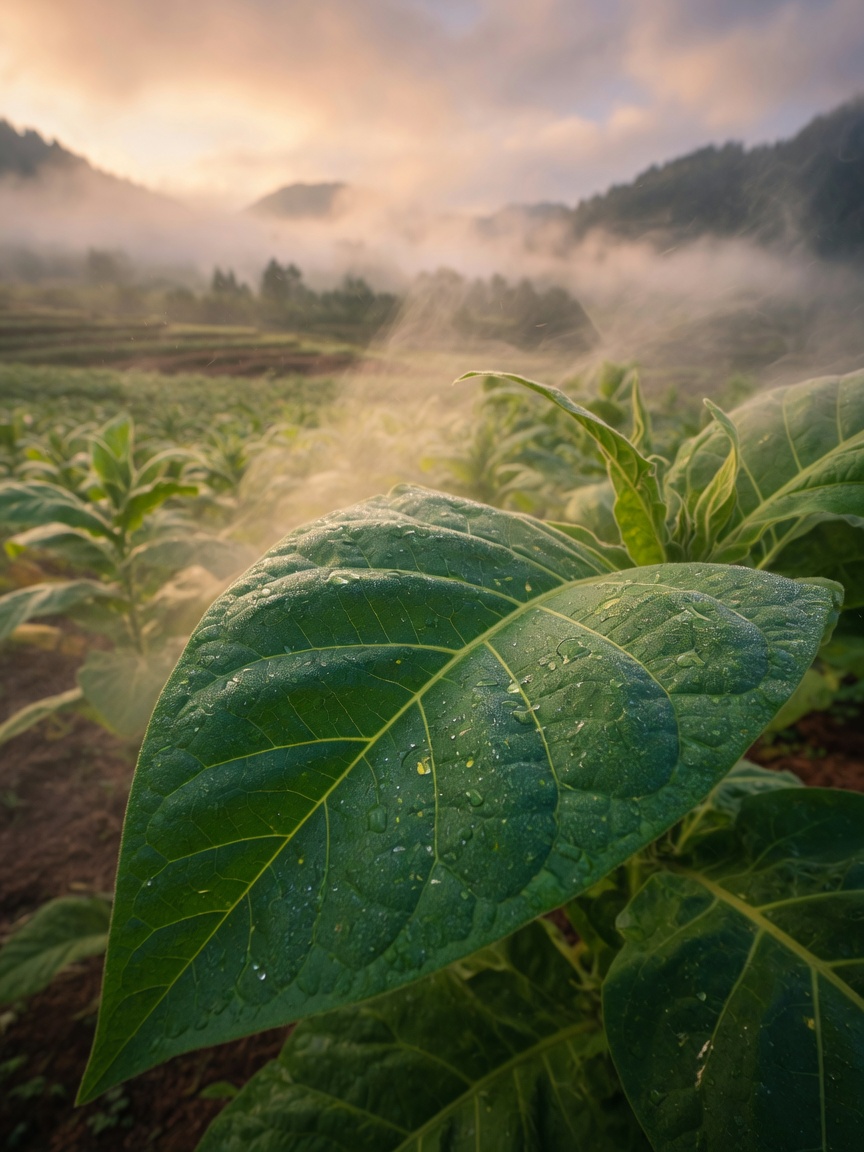
I remember one morning in Honghe Prefecture, Yunnan, standing on a hillside at fifteen hundred meters above sea level, watching mist rise over the tobacco fields as sunlight broke through the clouds — not dazzling, but carrying an indescribable "warmth." At that moment, an old tobacco farmer pointed at that faint glimmer of light and said to me, "This light is not shining on the leaves; it is shining into the aroma." Only years later, when I delved into the relationship between photosynthesis and tobacco secondary metabolism, did I truly grasp the depth of those words.
Light is not merely a source of energy; it is more like a precise chemist, conducting a silent alchemy within the cellular tissues of tobacco leaves through the subtle combination of sunshine duration and light intensity.
The Alchemy of Light: The Leap from Pigment to Aroma
Many people believe that tobacco leaf aroma is "grown," but in fact it is mostly "transformed."
From a biochemical perspective, the core aroma components of tobacco leaves — especially the neutral volatile compounds that determine style characteristics — largely originate from the degradation of plastid pigments such as chlorophyll and carotenoids. This brings out the most critical contradiction in light: the contest between sunshine duration and light intensity.
Sunshine duration determines the accumulation of "raw materials." During the field growth period of tobacco, especially at maturity, sufficient sunshine duration (usually required to be between 500 and 700 hours) ensures efficient photosynthesis, allowing the plant to accumulate enough dry matter and carbohydrates. Without enough hours of sunshine, the accumulation of organic matter in tobacco leaves appears "thin," directly leading to an insufficient total amount of aroma precursor substances.
However, if one pursues only hours while neglecting intensity, the result often swings to the other extreme.
I once observed a set of experimental data over a summer on the North China Plain. In those fields, sunshine duration was extremely high, but the light intensity on summer afternoons was extremely strong, even scorching. The results showed that although the dry matter content of the leaves was very high, the aroma style felt a little "agitated." This is because excessively strong light induces stress responses in the plant, causing part of the carotenoids to degrade too quickly and producing excessive pungent substances, while the proportion of those delicate degradation products with floral or fruity characteristics (such as neophytadiene and ionone) actually declined.
In contrast, highland production areas such as Yunnan and Guizhou, although their sunshine duration fluctuates considerably with seasons and clouds and rain, enjoy a superb "diffuse" quality of sunlight due to their high altitude and thin air. This "warm" light both sustains continuous photosynthesis and avoids physical damage to leaf tissue from strong light, allowing aroma precursor substances to accumulate and transform in a steadier, more coordinated manner. This is why highland tobacco leaves often possess that delicate, fresh and lasting light-aroma style.
The Soul of Fire: How Light Governs Burning Performance
If aroma is the "soul" of the tobacco leaf, then burning performance is its "bone."
An excellent tobacco variety must not only smell fragrant but also burn well — steady combustion, white ash, long smoldering time, and no self-extinguishing. The key indicator here lies in the ratio of potassium (K) to chlorine (Cl), as well as the coordinated relationship among sugars, nicotine and ash.
The influence of light on burning performance is indirect but decisive.
First is nutrient balance. Moderate light promotes the plant's absorption and transformation of potassium from the soil. Under conditions of sufficient light with moderate intensity, tobacco leaves can achieve orderly nutrient allocation. I once encountered a thorny case: in one region, due to prolonged overcast and rainy weather, the sunshine percentage during the field period was extremely low (below 25%), leaving that season's leaves looking green but with thin blades and thick midribs. After curing, these leaves showed abnormally high nicotine content but extremely low sugar and potassium content — when burned, the burn was unstable, producing heavy black ash and a pungent, acrid taste.
The reason is that under weak light, the plant, in order to survive, must compensate for insufficient photosynthesis by increasing the proportion of protein and total nitrogen. This imbalance of chemical composition directly destroys the potassium/chlorine ratio, preventing the leaf from forming a stable chemical balance during combustion and ultimately collapsing its burning performance.
Conversely, ample but moderate light promotes sugar accumulation and the effective transformation of potassium, allowing the leaf to maintain a "moist and mellow" state while burning. That sensation of soft flame and clean smoke during combustion is essentially an imprint left by light at the cellular level.
The Light-and-Shadow Map of Growing Regions: The Style Code Behind the Data
Highland diffuse-light regions
Such as Yunnan and Guizhou: hours fluctuate with the rainy season, but the diffuse light is gentle, allowing aroma precursors to accumulate and transform steadily, yielding a delicate, lasting light aroma.
High-intensity, high-hour regions
Such as the North China and Huang-Huai regions: ample hours and high intensity favor the accumulation of dry matter and rich components, supporting the heaviness of full aroma, but excess nicotine must be offset.
Through long-term observation of the major producing regions, we can sketch a clear "light-and-shadow map."
In Yunnan and the southwestern regions, we see a combination of "high altitude, high diffusion, moderate hours." Annual sunshine duration usually ranges from 1600 to 2500 hours; although limited by the rainy season, the diffuse light there is a natural asset for shaping light-aroma-type tobacco leaves. Under this light regime, leaves accumulate abundant carotenoids and, during degradation, produce extremely high-quality neutral aroma substances.
In the North China and Huang-Huai regions (such as Henan and Shandong), the style is completely different. Sunshine duration there is very ample, often exceeding 2200 hours per year on average, with relatively high light intensity. This ample, intense sunlight environment favors the accumulation of more dry matter and richer chemical components, supporting the heaviness required by full-aroma-type tobacco. But for growers, how to offset the excessive nicotine caused by strong light through water management and coordinated fertilizer application is a profound art.
As for Hunan and parts of the southern regions, due to topography and climate, the sunshine percentage is sometimes on the low side. This requires growers to be more meticulous in planting layout and variety selection, optimizing planting density or using terrain to shelter from wind and shade, in order to simulate a more ideal light environment as closely as possible.
Reflections in Practice: Light Is the Grower's "Invisible Lever"
As a tobacco practitioner, I have increasingly realized that our management of light is, in essence, an artistic orchestration of "time" and "intensity."
In actual operations, we cannot change the sun, but we can change the way leaves "perceive" sunlight. For example, by adjusting the transplanting date to optimize the light-receiving area in early growth; through scientific planting density, using mutual shading of leaves to regulate the field microclimate, achieving a shift from "strong light" to "scattered light."
In a field trial on a specific variety, I found that during vigorous growth, if one could slightly adjust field light intensity through gentle physical means — even with sunshine duration unchanged — the aroma quality of the leaves would improve markedly in steps. The benefit of such fine-tuning is often far more efficient than simply increasing fertilizer application.
In summary, sunshine duration sets the "ceiling" for aroma and burning performance, while light intensity determines the "texture" of quality. An excellent tobacco grower must not only know how to "supplement" through water and fertilizer, but also how to "regulate" through light and shadow.
Light is the most indispensable rhythm in the life of tobacco. When we learn to respect and follow this rhythm, the leaves growing in the sun will truly bloom with the deep and enchanting aroma that belongs to them.