How Different Processing Methods Change Tobacco Flavor Layering
The first time I truly realized that "processing matters more than variety for flavor layering" was in mid-October 2019, in the curing barn complex of a tobacco station near Yuxi, Yunnan. Two baskets of middle leaves from the same field, same stalk position, harvested on the same day: one basket went through the standard three-stage firing — yellowing, color-fixing, stem-drying — while the other, because the wet-bulb temperature dropped too fast in the early color-fixing stage, had its color set, but the ledger of sugar conversion and aroma precursors was noticeably "thinner." Two days later at a blind panel, the sample codes differed by a single letter, and the result was a clear honey-sweet → roast → short finish on one side, and scorched edges, dry bitterness, and raw green notes not cleaned up on the other. The variety hadn't changed; what changed was processing's addition and subtraction across flavor dimensions.
Later, I repeated the same logic twice more — in a fermentation room near Santiago, Dominican Republic (March 2022), and in an aging warehouse for cigar materials in China (November 2023): Curing/heat-treatment paths set the skeleton, fermentation reduces noise and pushes the aroma peak, and aging slowly stews out harmony and late-stage layering. The three aren't about "which is better" — they each rewrite different sensory dimensions. Below, I'll lay it out in terms I can touch, measure, and have stepped in trouble on.
I. First, Break Down "Flavor Layering" into Conversable Dimensions
In the industry, saying "good layering" is often treated as mysticism. When I personally evaluate samples and align with process technicians, I consistently use the following set of dimensions for scoring (each 0–5, not for public release, sufficient for internal use):
| Flavor Dimension | Approximate Corresponding Substance/Process Impression | Processing Stage Most Likely to Affect It |
|---|---|---|
| **Raw Green / Unripe** | Chlorophyll residue, lipoxygenase-pathway aldehydes, insufficiently converted grassy notes | Insufficient yellowing in curing, overly rapid air-drying |
| **Sugar Sweet / Honey Sweet** | Reducing sugars, some early Maillard products | Sugar retention in flue-curing, timing of color-fixing |
| **Roast / Nut / Cocoa** | Maillard (pyrazines, furans, Strecker aldehydes, etc.) | Mid-to-late fermentation, aging, localized heating |
| **Wood / Spice / Floral** | Carotenoid and terpene degradation, some neutral aroma compounds | Fermentation peak zone, aging |
| **Ammonia / Harshness / Throat Impact** | Nitrogenous compounds, free alkaloids, uncoordinated nitrogen-sugar ratio | Fermentation reduces ammonia, aging tempers harshness |
| **Astringent Bitter / Dry Bitter** | Polyphenols, excessive browning, scorching | Overheating during color-fixing, burning the pile, over-fermentation |
| **Acidity / Balance** | Organic acid profile, pH, and acid-alkali impression of smoke | Fermentation metabolism, aging esterification |
| **Finish Length & Cleanliness** | Residual irritation + remnant aroma + off-notes | Jointly determined by all three stages |
One sentence is enough to remember:
**Curing/curing mainly decides whether you have a "sweet skeleton" and whether you have a "raw green tail"; fermentation decides whether you can suppress ammonia and astringency and push aroma to its peak; aging decides whether, after the peak, it can turn into a fine, long, clean layering.**
II. Curing (Heat-Treatment Path): Locking in Sweetness, Roast Aroma, and Eliminating Raw Green in Days
What "curing" refers to here is fundamentally flue-cured style forced-air curing — the leaf isn't smoked by open flame, but controllable dry-bulb/wet-bulb temperatures transform fresh leaves into storable, processable raw tobacco. Air-cured and sun-cured tobaccos also alter layering, but the mechanisms differ; within flavor layering the most dramatic "where does sweetness come from" often starts with the flue-cured line.
1. A Typical Timeline I Followed (Order of Magnitude, Not the Only Standard)
For those 2019 middle leaves, the parameter card hung in the bulk curing barn was roughly:
| Stage | Dry-Bulb Temp (approx.) | Time Scale | What the Process Does | What It Does to Flavor |
|---|---|---|---|---|
| **Yellowing** | 35–40℃ | Tens of hours | Chlorophyll degradation, starch → soluble sugars | **Reduces raw green**, **lays groundwork for sugar sweet** |
| **Color-Fixing** | Gradually rising to approx. 50–55℃ range | Tens of hours | Locks in yellow color and chemical state, controls browning | **Fixes the sweet skeleton**, begins to produce **roast undertone** |
| **Stem-Drying** | Higher (often above 60℃ magnitude) | Another tens of hours | Main vein dehydration, safe storage | If too aggressive: **bitter scorch↑, sweetness↓** |
The whole process commonly runs in the 5–8 day range (varies by stalk position, loading density, barn type). Compared to cigar air-curing which often takes weeks, flue-curing is a short-cycle, tightly temperature-controlled "quick-fire shaping" method.
2. What It Strengthens, What It Weakens
Clearly Strengthened:
If temperature and humidity cooperate during yellowing, starch conversion is thorough and reducing sugars are "retained." This is the chassis for that clear sweetness in flue-cured cigarette tobacco. Without this stage, no amount of later flavoring can fix it — it's like sprinkling sugar powder into an empty bowl — it floats, it doesn't cling to the leaf.
The heating process from color-fixing to stem-drying pushes partial sugar thermal degradation and Maillard preludes. At the flavor level, this shows as a layer of warm roast beneath the sweetness, not pure sweet.
Not flavor itself, but when panelists evaluate, bright yellow samples often get sweetness bonus points first — that's just how the process reality works.
Clearly Weakened:
Moving to color-fixing without adequate yellowing is the most common accident I've seen. Those 2019 leaves with "premature color-fixing" — the dry-bulb climb wasn't extreme, the problem was wet-bulb dropping too fast, leaf internal conversion incomplete. Result: appearance barely passed, but in the mouth there was a grassy + thin prickle, sweetness knocked down by half.
Insufficient stem-drying risks mold in storage; but rushing the stem-drying by cranking up the temperature scorches leaf edges, directly raising the bitterness dimension.
Dimensions Easily Injured:
- Floral, Delicate Fruity Notes: The flue-cured path isn't incapable of producing these, but the short cycle and high heat lean more toward "sweet + roast," while delicate terpene floral notes are often richer under air-curing or long fermentation paths.
- Deep Cocoa, Cedar Long Finish: These are more the domain of fermentation + aging — don't expect the curing barn to deliver them all in one day.
3. Personal View (Curing Stage)
The position I assign to curing is:
**It changes "whether you can taste sweetness and whether you can remove raw green," not "whether you can drink a wine-like layering."**
If you want a clear, sweet, stable-burning flue-cured skeleton, it's worth tuning every degree of wet-bulb temperature in the curing parameters; if you want a cigar-style long layer of wood-cocoa after ammonia is exhausted, don't bet everything on the curing barn.
Pitfalls I've stepped in (shareable with process newcomers):
- Overloading the barn (that time I hung about 15% more leaf than normal in one chamber): inter-layer temperature and humidity became uneven, producing "sweet on top, raw green on bottom" within the same basket.
- Following a yellowing schedule by the clock, not by the leaf: the chart said 48 hours, but the veins were still green, and we forced entry into color-fixing — raw green gets written into the final layering, and later fermentation can only partially remedy it, never fully clean it.
III. Fermentation: Short Cycle, High Intervention, Specializing in Ammonia and Astringency While Pushing the Aroma "Peak"
Fermentation in tobacco is not the single-yeast story of winemaking. A more accurate description is: under controlled temperature, humidity, and bulk/room conditions, microorganisms + residual enzymes + non-enzymatic reactions (Maillard, pigment degradation, etc.) rewrite the chemical profile together. Cigar tobacco, some air-cured and sun-cured tobaccos, and blends requiring further processing are the most common applications.
1. On-Site Parameters: Two Sets of Numbers I Recorded
(1) Fermentation Room Near Santiago, Dominican Republic, March 2022
- Pile type: traditional leaf pile, moisture content managed in the "damp but not soggy" range (hand-feel — can form a ball when squeezed, loosens when released; this is an industry hand-feel description, more practical than quoting dry percentages).
- Pile core temperature: normal operation commonly fluctuated in the 40–50℃ range; once, a turn was delayed by about 12 hours, and the core surged to near the 60℃ threshold, prompting emergency spreading.
- Cycle: this batch of wrapper-related material underwent about 18–21 days for one-stage observation; the master's verbal standard was "smell the ammonia come down, leaf color evens out, hand-tear toughness is present."
(2) Literature and Domestic Studies Repeatedly Cite "Aroma Inflection Point" Magnitudes
- In bulk fermentation, some neutral aroma compounds and Maillard-related products often peak around 14–21 days;
- Artificial/room fermentation also has reports of an inflection point around 25 days — after which total levels may not continue rising, and may even decline.
My experience aligns with these figures: fermentation is not better the longer it goes. Past the peak, layering shifts from "rich, low off-notes" toward "hollow, dry-bitter, like it's been washed out."
2. What It Strengthens, What It Weakens
Clearly Strengthened:
The Maillard pathway is more active in hot, humid piles: pyrazines, furans, Strecker aldehydes contribute a "roasted almond, cocoa husk, caramel edge" sensation. This is the most valuable addition fermentation provides on top of a pure flue-cured skeleton.
Carotenoid degradation (e.g., damascone-related impressions), cembrane degradation products, etc., often rise and then modulate during fermentation. At the flavor level, it shifts from "a leaf's sweet-bitter" to "being able to name second and third layers."
For the same batch of heavily raw and irritating leaves, after two to three weeks of fermentation, the most obvious change on the sensory panel is often: it's smokable, it's not harsh, the aromas start to fall into formation.
Clearly Weakened:
This is one of fermentation's main jobs. Nitrogenous compounds are transformed, volatilized, and redistributed, reducing the alkaline irritation of the smoke. In that 2022 batch, opening the pile before fermentation was pungent with ammonia; after three turns, at the same distance, the ammonia sensation dropped markedly — the nose reported before the instruments.
Polyphenols and related astringent compounds are partially degraded/transformed during fermentation, reducing oral astringency. Only then can "layering" be discussed — otherwise astringency covers everything.
If you prefer an extremely fresh, herbaceous top note, deep fermentation may flatten it. This is a style choice, not a pure defect.
High-Risk Injuries:
| Problem | Common Cause | Flavor Consequence |
|---|---|---|
| **Burning the Pile** | Temperature loss of control, delayed turning | Burnt bitterness, cloying sweetness, irritation rebound |
| **Over-Fermentation** | Continuing past the inflection point | Aroma volume drops, hollow, woody dry sensation |
| **Mold** | Excessive moisture, poor ventilation | Mold note — instant disqualification, layering zeroed out |
| **Stopping Before Ammonia Is Thoroughly Reduced** | Insufficient cycle or poor leaf quality | Even later aging struggles to fully clean it |
3. Personal View (Fermentation Stage)
**Fermentation changes the "noise floor" and the "first half of the aroma ceiling."**
It strengthens cocoa — roast — coordination, and weakens ammonia — astringency — raw irritation; but it also eats up some freshness, and if overheated or overextended, it can scorch or wash out the layering.
My own operating principles are crude but workable:
IV. Aging: Slow Stewing From Months to Years, Turning "Having Aroma" Into "Having Layering"
Aging and fermentation are often conflated. I follow the industry's common distinction:
- Fermentation: artificial, high intervention, days to weeks, pile temperature can rise significantly;
- Aging: relatively gentle long-term storage under warehouse conditions, months to years, changes like a slow fire.
Both share overlapping chemical engines (residual enzymes, microorganisms, oxidation, Maillard, esterification), but the rates and risk profiles differ.
1. Real Time Perception in the Warehouse
In November 2023, a domestic warehouse compared samples from the same production area, same grade, fermented then stored for 6 months, 18 months, and 36 months (temperature and humidity per warehouse protocol, not casually left at home):
| Aging Duration | My Recorded Subjective Layering Changes |
|---|---|
| **~6 months** | Irritation continues downward, aroma becomes "whole," but the third layer is still thin |
| **~18 months** | Wood/dried fruit/cocoa husk clearer, finish lengthens, sweet-bitter more cohesive |
| **~36 months** | Finer, cleaner; if storage leans dry, occasional "hollow, thin" — needs re-humidification conditioning before re-evaluation |
This is not a universal formula — the aging logic for burley, flue-cured, and cigar tobacco are not completely identical. For example, some views hold that the chemical reactions between sugars and amino acids carry significant weight in flue-cured aging; cigar leaf often still strongly correlates with microorganisms and fermentation history. But "irritation down, coordination up, late-stage aroma emerges" as the main curve is something I've repeatedly observed.
2. What It Strengthens, What It Weakens
Clearly Strengthened:
Aging's most valuable output is often not a "more explosive aroma," but aroma that stays put, off-notes that don't drag on. Layering often comes from finish structure, not from the first second of entry.
Slow oxidation, gradual Maillard, and esterification round sharp top notes. It's akin to letting new spirits age until you can discern barrel notes and dried fruit stages — the analogy isn't strict, but the sensory logic is close.
After irritating nitrogen and uncoordinated components decline, the original acidity and sweetness "make room" for each other, and in sensory evaluation one starts to see the so-called layering transitions (changes across entry — mid-palate — finish).
Clearly Weakened:
Provided fermentation/curing left no fatal flaws. Aging can polish, but it cannot resurrect the dead.
Some people like this punch and consider it "strength"; I prefer to label it an unfinished state. Aging trades for roundness at the cost of losing some aggression.
Possible Injury:
- Total Aroma Volume: Too long, too dry, or repeated improper opening of packages — volatilization and oxidation may thin the aroma, making the layering "thin and clean" — clean is an advantage, thin is a cost.
- Mold and Warehouse Taint: When humidity is out of control, an aging warehouse can wreck an entire season's inventory. In 2021, I saw localized mold spots from condensation at a warehouse corner, downgrading an entire pallet — flavor discussion ended right there.
3. Personal View (Aging Stage)
**Aging changes the "resolution" along the time axis.**
Fermentation gives you the peak and noise reduction; aging separates the lines within that peak — which part is wood, which part is cocoa, which part is the sweet tail. Without a baseline of aging, much of what is called "layering" is really just "intensity."
My trade-offs:
- For sensory education samples, I'd rather have an 18+ month coordinated sample than a "just off fermentation, very punchy aroma" sample — the latter teaches impact, not layering.
- For supply chain pacing, aging means cost and capital tied up; so industry tends to trade between fermentation intensity and aging time. Personal view: don't offload ammonia reduction that should be done in fermentation onto aging to tough it out, or the warehouse may still harbor restless irritation after three years.
V. Summary Table: Addition and Subtraction of Three Processing Methods on Flavor Layering
| Flavor Dimension | Curing/Heat-Treatment Path | Fermentation | Aging |
|---|---|---|---|
| Raw Green / Unripe | **↓↓** (when yellowing is adequate) | **↓** | **↓** |
| Sugar Sweet / Honey Sweet | **↑↑** (flue-cured sugar retention) | → or mild ↓ (sugar metabolized/reacted) | → more cohesive, more stable |
| Roast / Nut / Cocoa | **↑** (shallow) | **↑↑** | **↑** (finer) |
| Wood / Spice / Floral | Limited | **↑↑** (style-oriented) | **↑** (layers emerge) |
| Ammonia / Irritation | Depends on color-fixing and leaf quality | **↓↓** | **↓** |
| Astringent Bitter / Dry Bitter | **↑** if overheating | Normal **↓**, pile burn/over-fermentation **↑** | **↓** (barring abnormal warehouse conditions) |
| Finish Length | Short-to-medium, clear | **↑** | **↑↑** |
| Overall Layering | Builds skeleton | Builds peak and noise reduction | Builds resolution and completeness |
How to read the table:
- If you want sweet, clean, easy-burning skeleton → focus on curing/heat-treatment first.
- If you want cocoa — wood — low ammonia → fermentation is the main battlefield.
- If you want late stage that tells a story, not rough → give aging time and warehouse discipline.
VI. Three Judgments I'd Write Into My Work Memos
Judgment 1: Layering is not "added by flavoring," it is "developed after noise is subtracted."
Many people start by looking for aroma-enhancing processes, but refuse to remove raw green, ammonia, and astringency. Discussing layering before noise reduction is like trying to identify harmony in noise.
Judgment 2: Curing sets the tone, fermentation sets usability and style peak, aging sets completeness.
If the tone is wrong (should be sweet but isn't, should be clean but isn't), the latter two stages are cosmetic surgery, not bone restructuring; if fermentation isn't thorough, aging is chronic procrastination; if aging is cut short, the product can sell, but in sensory evaluation it lacks "what comes after the third puff."
Judgment 3: Every stage has a symmetrical risk of "too much is as bad as too little."
- Overly aggressive curing → burnt bitterness kills sweetness;
- Overly long or hot fermentation → aroma passes its peak, hollow or pile-burn;
- Overly dry or disorderly aging → thin, hollow, or mold.
Good processors and winemakers share a similarity: they don't crank reactions to maximum — they stop slightly before the peak or in the window where it's still harmonious after the peak.
VII. If You Can Only Change One Process Stage, How to Prioritize
Choose by target, not by mythology:
Priority: Curing curve (adequate yellowing, color-fixing wet-bulb, stem-drying not scorching edges) ≫ Warehouse aging ≫ Deep fermentation.
Priority: Fermentation (pile temperature, turning, cycle inflection point) ≫ Months of aging ≫ Flue-cured sugar-retention logic (cigar leaf chemistry is fundamentally different).
All three are needed: curing/heat-treatment leaves no dead raw green → fermentation reduces noise and pushes aroma → aging opens up the late stage. Missing any link, the story breaks at some puff.
Finally, let me draw the boundary: Processing changes sensory usability and style expression, it does not turn tobacco into a harmless substance. The health risks of combustion or high-concentration exposure do not disappear just because the tobacco is "more mellow from fermentation" or "aged three years." I write about processing to clarify flavor layering, not to endorse any form of consumption.
If you have a specific batch of leaves in hand — tell me whether it's a flue-cured or cigar route, whether it's raw leaf, in fermentation, or already in storage — the next useful step is not to rehash concepts, but to: run a three-point sampling (before treatment / mid-fermentation / aged sample) on the same batch, blind-evaluate it, and fill out the dimension table above. Once layering is written as scores, which part of processing to strengthen and which to weaken no longer relies on arguments.
Key Parameters
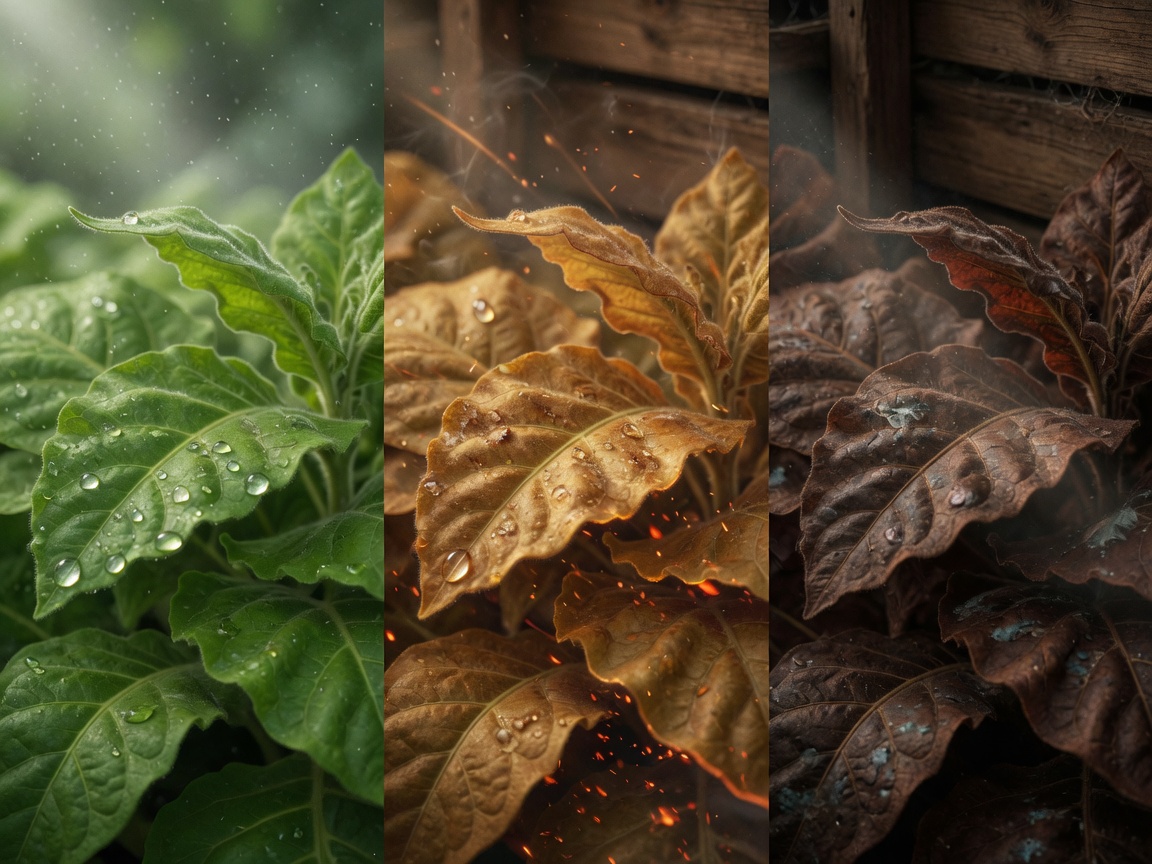
Curing vs Fermentation: Core Comparison
Curing / Heat-Treatment
- Builds sweet skeleton & honey base
- Reduces raw green & chlorophyll
- Produces shallow roast / crust note
- Short cycle (5–8 days), tight control
- Overdone: bitter scorch↑, sweet↓
Fermentation
- Reduces ammonia & astringency
- Pushes roast/nut/cocoa profile
- Enhances wood notes & coordination
- Aroma inflection ~14–21 days
- Overdone: hollow, dry-bitter
Aging: Slow-stewing layering resolution
Strengthened
- Finish length & cleanliness
- Cocoa, cedar, dried fruit notes
- Acid-sweet-bitter balance
Weakened
- Raw irritation, green residue, roughness
- Excessive sharp "new leaf punch"